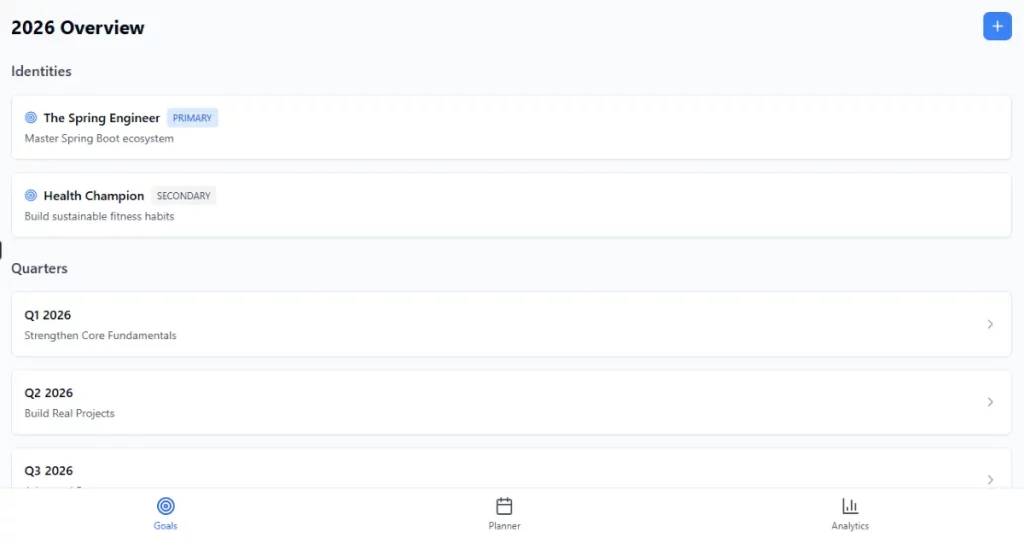
Strategic planning for new year goals is something I’ve avoided for a long time, mostly because past plans never survived real life. Going into 2026, I decided to approach it differently, with structure, constraints, and honesty instead of motivation and vague resolutions.
Introduction
I’ve been trying to find a new opportunity in software engineering, and it has been a very rough journey.
For the past few years, I have made it to different stages of a few interviews. Sometimes HR, sometimes technical, sometimes behavioural. Each time, I felt close, but not close enough. After a while, I stopped trying to explain it away.
At the end of the day, the gap was clear. Either my technical depth wasn’t strong enough, or my communication wasn’t where it needed to be.
So instead of hoping things would somehow improve, I decided to take a more intentional approach. This post documents the strategic plan I’m using to level up my skills and myself going into 2026. This is my first time trying a plan like this, so I’m treating it as a realistic experiment, not a guaranteed solution.
TL;DR
- This post documents my approach to strategic planning for new year goals in 2026.
- The plan is identity-based, not outcome-based.
- It’s designed around real constraints, not motivation or perfection.
- The structure flows annual → quarterly → weekly.
- Focus rotates by quarter to allow depth without burnout.
- Weekly execution is time-boxed and intentionally flexible.
- Success is defined as 70-80% consistency, not 100%.
- A layered compensation system (daily, weekly, quarterly) keeps the plan sustainable.
- Bad weeks trigger simplification, not punishment.
- This is a first attempt and a living experiment, not a guaranteed formula.
If you only read one thing:
The goal isn’t to do more. It’s to stay in the system long enough for progress to compound.
The Guide Behind This Plan
Before getting into the details, it’s important to explain how this plan was designed.
This isn’t a productivity hack or a rigid goal-setting system. It’s a simple framework built around identity, constraints, and consistency.
Start With Identity, Not Goals
Instead of asking “What do I want to achieve?”, I asked:
Who do I want to become by the end of the year?
Goals change. Identity compounds.
Each identity represents a long-term direction rather than a short-term outcome. This shift is the foundation of my strategic planning for new year goals.
Design for Constraints, Not Motivation
This plan assumes reality:
- Some weeks will be busy
- Some weeks will be low-energy
- Motivation won’t be consistent
Everything is designed around minimum viable habits and limited weekly commitments. If a plan only works during perfect weeks, it won’t last.
Use Time Horizons to Reduce Overwhelm
The structure flows downward:
- Annual vision sets direction
- Quarterly objectives control focus
- Weekly plans drive execution
Separating these layers is what makes strategic planning for new year goals manageable instead of overwhelming.
Rotate Focus to Go Deep Without Burning Out
Trying to improve everything at once leads to shallow progress.
Instead, this plan:
- Rotates primary focus areas each quarter
- Keeps other skills in maintenance mode
This allows depth without sacrificing consistency.
Treat the Plan as an Experiment
This is not a promise and not a guarantee.
It’s a structured experiment that I’ll adjust as I learn what actually works. That mindset alone removes a lot of unnecessary pressure.
My Annual Vision
Instead of setting vague resolutions, I defined five identities I want to grow into over the year.
Career Identities
1. The Spring Engineer
I deeply understand Spring and can build reliable, maintainable systems.
2. The Problem Solver
I improve my algorithmic thinking through consistent data structures and algorithms practice.
3. The Systems Designer
I think in terms of architecture, trade-offs, and scalable design principles.
Personal Identities
4. The Healthy Person
I train regularly, stay active, and maintain strong physical energy.
5. The Confident English Speaker
I speak clearly and confidently, improving through regular practice and feedback.
These identities give direction without locking me into rigid outcomes.
Quarterly Objectives (3–6 Month Focus)
To make the year achievable, the plan uses quarters as focus units.
Each quarter follows the same rules:
- Rotating primary focus to allow deeper work
- Keeping other identities active in maintenance mode
- Using simple, memorable quarterly themes
- Following a skill-building cycle
(learn → build → refine → demonstrate)
Each quarter includes:
- Primary goals (deep focus)
- Secondary goals (maintenance)
Q1 2026 – Foundation & Consistency
Theme: Strengthen core fundamentals
Primary Goals
Spring / Spring Boot Mastery
The goal here is to strengthen fundamentals, not rush complexity.
Focus areas include:
- Bean lifecycle
- Dependency injection and IoC
- Auto-configuration
- AOP and proxies
- Transaction management
I’ll build one focused mini-project, such as a file-processing or scheduling system (TBD), using Spring Boot, Docker, Kubernetes, and either AWS or Azure. This project supports my broader strategic planning for the new year goals by prioritizing correctness and structure.
DS&A
Consistency matters more than volume at this stage.
Weekly structure:
- Max 45 minutes per day
- Problem count is flexible:
- Easy: up to 3
- medium: up to 2
- Hard: up to 1
- Focus on sliding window, binary search, two pointers, trees, and graphs
Pattern tracking will be used only if it actively improves problem-solving, not as busywork.
Secondary Goals
- System design: one foundational topic per week
- Health: three workouts per week
- English: 15–30 minutes of daily speaking practice
Q2 2026 – Build & Apply
Theme: Turn knowledge into real systems
This quarter focuses on applying what I’ve learned so far, a critical step in strategic planning for new year goals.
Primary Goals
Spring / Spring Boot
Build a real-world style service, such as:
- Job scheduler
- Notification service
- Batch processing pipeline
This project will include pagination, logging, metrics, retries, and exception handling.
DS&A
Maintain the same weekly structure from Q1 to preserve momentum and stability.
Secondary Goals
- System design: intermediate topics, one per week
- Health: increase to 3–4 workouts per week
- English: record one speaking session per week and review progress
Q3 2026 – Elevation & Depth
Theme: Reach intermediate-level architectural thinking
At this stage, strategic planning for new year goals shifts toward depth.
Primary Goals
System Design
Topics include:
- Event-driven architecture
- CQRS
- Distributed transactions
- Sharding
I’ll also produce two polished system design documents for future interview use.
DS&A
By Q3, the focus shifts from volume and patterns to depth and endurance.
The goal here isn’t to solve as many problems as possible, but to think longer and more carefully about harder problems, especially in areas that require structured reasoning.
Focus areas:
- Dynamic programming fundamentals
- Graph algorithms
- Tries
Weekly structure:
- Max 45 minutes per day
- Prefer:
- One hard problem when appropriate
- Otherwise, a medium → hard progression
- Allow multi-day work on the same hard problem
At this stage, success isn’t defined by how many problems get checked off.
Success is showing up consistently and engaging deeply, even if a single problem spans multiple days.
Secondary Goals
- Spring: refactor the Q2 project using better architectural patterns
- Testing: add Testcontainers for integration tests
- Health: introduce progressive overload
- English: explore structured alternatives to conversation events
Q4 2026 – Consolidation & Showcase
Theme: Demonstrate mastery and solidify identity
This quarter brings everything together, which is the final stage of my strategic planning for new year goals.
Primary Goals
Combined Spring + System Design Project
Build a portfolio-worthy application that combines:
- Spring Boot
- System design principles
- Clean architecture
- Observability
- Docker and optional Kubernetes
DS&A Review
Revisit all major patterns and create a concise summary document, solving 20 curated problems for consolidation.
Secondary Goals
- Health: maintain consistent exercise habits and reflect on energy levels
- English: prepare and record a five-minute spoken summary of the year
Weekly Core Structure
This is where strategic planning for new year goals becomes executable.
The weekly structure prioritizes consistency, energy management, and identity reinforcement over perfect execution.
Spring / Spring Boot – 2 Sessions
- Monday: deep learning (internals, concepts)
- Thursday: application work (project, refactor, tests)
⏱ 1–1.5 hours each
DS&A – Daily (Low Pressure)
- Monday–Friday: 30–45 minutes
- Difficulty varies by day
- Weekends: optional light review or full skip
DS&A stays active as a background identity, not a stressor.
System Design – 1 Primary Session
- Wednesday: 1–1.5 hours
Optional:
- Saturday: second session only if energy is good
Workouts – 3-4 Times per Week
Rotation A
- Tuesday
- Thursday
- Saturday
Rotation B
- Wednesday
- Friday
- Sunday
Workout days help reset cognition. Non-workout days free up energy for deep focus.
English – Daily Anchor + Weekly Depth
Daily English (Anchor Habit)
- Monday–Friday (optional Sat/Sun): 10–15 minutes
- Attached to a stable routine:
- right after waking up
- after lunch
- or after dinner
This can be:
- shadowing
- free speaking
- explaining your day out loud
- talking to ChatGPT voice
Weekly English Review (Light but Intentional)
- Saturday or Sunday (after weekly review): 30–45 minutes
Purpose:
- review 1–2 recordings
- notice recurring patterns
- optional corrections
A Concrete Example Week
To make this less abstract, here’s what a normal week might look like.
Example: Normal Week
Monday
- DS&A (30–45 min)
- Spring deep session
- English (10–15 min anchor)
Tuesday
- DS&A
- Workout
- English (10–15 min)
- No deep work (recovery day)
Wednesday
- DS&A
- System design session
- Workout
- English (10–15 min)
Thursday
- DS&A
- Spring project session
- English (10–15 min)
Friday
- DS&A
- Workout
- English (10–15 min)
Saturday
- Optional:
- system design second session or
- light DS&A review or
- full rest
- English weekly review (30–45 min)
Sunday
- Weekly review (20–30 min)
- Plan the next week
- English weekly review (30–45 min)
Final Adjusted Weekly Commitments
Weekly commitments
- Spring / Spring Boot: 2 deep sessions
- DS&A: daily, max 45 minutes
- System design: 1 session (2 if time and energy allow)
- Workouts: 3 per week
- English: daily anchor + optional weekly review
This setup is:
- ambitious but realistic
- identity-consistent
- sustainable for a full year
Weekly Planning Rules
- Plan once per week (15–25 minutes)
- Plan by identity, not by tasks
- One focus per identity
- Time-box everything
- Decide week intensity upfront
- Plan only seven days ahead
- Schedule sessions immediately
Weekly Success Criteria
Success is not perfection.
- 70–80% completion = success
- Spring: at least 1 session
- DS&A: at least 4 days
- System design: 1 session
- Health: 3 workouts
- English: daily anchor or weekly review completed
Anything beyond that is extra.
Compensation: How This Plan Stays Alive Long-Term
One thing that broke almost every past plan for me wasn’t motivation or discipline.
It was the lack of a proper compensation system.
So before closing this out, I want to explain how compensation fits into my strategic planning for new year goals, because without this, none of the structure above matters.
What “Compensation” Actually Means
In modern psychology, compensation is not just rewards.
A good compensation system serves three roles:
- Reinforcement – makes desired behavior more likely
- Recovery – prevents burnout and cognitive fatigue
- Stability – allows imperfection without quitting the system
If compensation only handles reinforcement, it fails.
If it ignores recovery and stability, it collapses fast.
Compensate the Process, Not the Outcome
This is the most important rule.
What Doesn’t Work
- “If I finish this project, I’ll reward myself.”
- “If I solve 10 problems, I deserve something.”
This creates:
- pressure
- avoidance
- all-or-nothing thinking
What Works
Compensation triggers when I honor the plan, not when I perform perfectly.
If I show up and execute the planned session, I get compensated.
Why this works:
- I control effort, not outcomes
- It reinforces identity
- It keeps momentum during hard weeks
Compensation should trigger when you show up, not when you win.
The Compensation Structure (Three Layers)
Instead of one big reward, this plan uses layered compensation.
Each layer serves a different psychological purpose.
Layer 1: Daily Micro-Compensation
Purpose
- Reinforce the habit loop
- Provide immediate relief
- Keep motivation lightweight
These must be:
- small
- cheap
- immediate
- guilt-free
Examples (pick 2–3 max):
- A good coffee or snack
- One episode of a show
- Leisure reading
- A walk with music
Optional:
- 15–30 minutes of guilt-free YouTube, Reddit, or gaming
Rule
You earn this by showing up, not by doing well.
Example:
“I did my Spring session. I’m done. I relax.”
No bargaining.
Layer 2: Weekly Compensation (Most Important)
This is the layer that keeps the system alive.
Purpose
- Prevent burnout
- Give closure to the week
- Reinforce consistency
Weekly Rule
If I complete ~70–80% of my planned sessions, the week counts as successful.
Not 100%.
Not perfection.
Weekly compensation ideas
- Eating out or ordering food guilt-free
- Watching a movie
- Buying a small item (book, gear, tool)
- Longer gaming or hobby session
Why 70–80%?
Because:
- Life happens
- Flexible goals outperform rigid ones
- This prevents quitting during busy weeks
This rule directly supports strategic planning for new year goals by prioritizing longevity over intensity.
Layer 3: Quarterly Compensation (Meaningful & Memorable)
Purpose
- Anchor long-term motivation
- Create emotional association with effort
- Mark progress in your life narrative
Quarterly compensation should be:
- experiential
- identity-affirming
- slightly special
Examples
- Short trip or staycation
- Buying something you’ve wanted for months
- A low-intensity week
- Enrolling in a course or workshop
- Upgrading equipment (chair, keyboard, gym gear)
Key rule
Quarterly compensation is earned by consistency, not raw achievement.
You don’t need to finish everything.
You need to stay in the system.
Recovery Is Part of Compensation (Non-Negotiable)
Most people forget this.
Recovery isn’t laziness. It’s maintenance.
Mandatory Recovery Rules
- At least one full low-effort day per week
- At least one reduced-intensity week per quarter
- No guilt attached
This prevents:
- identity fatigue
- motivation collapse
- resentment toward the plan
The Compensation Safety Net (For Bad Weeks)
Bad weeks will happen.
So the response needs to be defined before they happen.
The Rule
A bad week does not remove compensation.
It triggers simplification, not punishment.
Bad week response
- Reduce planned sessions by 50%
- Keep identities alive at minimum viable level
- Still allow weekly compensation
This preserves the most important identity:
“I am someone who doesn’t quit.”
How Compensation Supports Each Identity
- Career identities (Spring, DS&A, System Design)
Keeps cognitive work sustainable and prevents stress association - Health identity
Recovery prevents injury and burnout - English identity
Low-pressure reinforcement keeps confidence high
Simple Compensation Template
You can literally write this somewhere:
Daily
- If I show up → I relax guilt-free
Weekly
- If I hit ~70–80% → I enjoy a chosen reward
Quarterly
- If I stay consistent → I celebrate meaningfully
Bad weeks
- Reduce load, not rewards
A Small Side Project to Support This Plan
One practical problem I’ve run into with plans like this is tracking and follow-through.
Spreadsheets get messy. Notes drift. And over time, it becomes harder to see whether the system is actually working.
So alongside this plan, I’m planning to build a small web app to support it. Nothing fancy. Just something that helps me:
- define identities and focus areas
- plan weeks quickly
- track consistency instead of raw output
- review patterns over time
The goal isn’t productivity optimization or gamification. It’s visibility and accountability.
I’ve written a separate post that walks through the system design and architectural decisions behind this app, including the trade-offs I’m making and what I’m intentionally keeping out of scope.
You can read that here: Goal Tracker: Designing a System That Connects Goals to Daily Execution
For now, the app is just another experiment. If it turns out useful, I’ll iterate on it. If not, that’s still a valid outcome. Either way, it fits naturally into this broader approach to strategic planning for new year goals.
Closing Thoughts
Strategic planning for new year goals doesn’t have to be rigid or motivational.
This plan is designed to work within real constraints and evolve over time. Some parts will change. Some parts may fail. That’s expected.
For now, this approach to strategic planning for new year goals gives me clarity, direction, and a better way to measure progress than just working harder.
Thank you for reading, and happy new year!
NOTE: Feel free to use the template I’ve shared here. Tweak it, simplify it, or adapt it to your own situation. I’d love to hear how it works for you, or see the version you come up with yourself.